
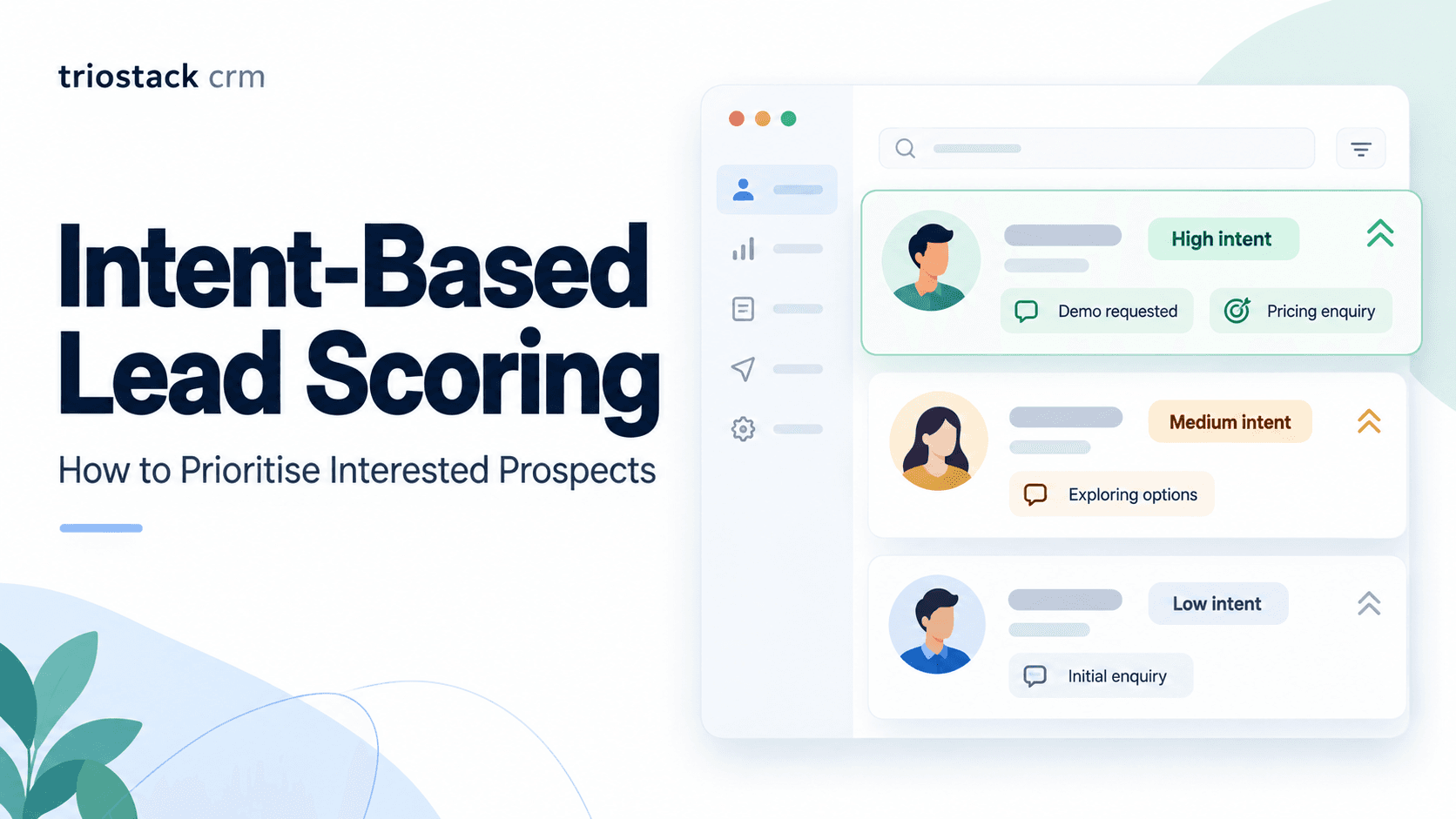
Intent-based lead scoring helps small and medium businesses sort through inquiries and focus on prospects most likely to convert. For Indian SMBs that manage customer conversations across WhatsApp, phone calls, and website forms, this approach connects signals from multiple touchpoints into a single, actionable score. With Triostack CRM, you can combine a shared WhatsApp inbox, templates, flows and automation triggers, along with AI-powered call transcription and automatic lead assignment to act quickly on hot leads. This article explains what intent scoring is, which signals matter, and how to implement it in practical, real-world steps.
Understanding Intent-Based Lead Scoring
Lead scoring assigns a numeric value to each contact based on how likely they are to become a customer. Intent-based scoring goes beyond demographic data and past activity by weighing signals that indicate a buyer is actively evaluating a solution. For SMBs, intent signals can come from interests shown in messages, responses during calls, and behavior across channels. The goal is to surface a short list of highly engaged leads so your sales or customer outreach teams can prioritize follow-ups and allocate time efficiently.
Unlike static scoring rules, intent scoring adapts as new information arrives. For example, a lead who asked for pricing details in a WhatsApp conversation and then scheduled a call using the mobile app may receive a higher score than one who only visited a product page. In Triostack CRM, you can configure how signals feed into lead scores, and you can see how scores evolve as conversations develop.
Signals That Indicate Buying Intent
Intent is a blend of interest signals, engagement depth, and the likelihood of a decision being made soon. Here are practical categories to consider, with examples you can apply to your Indian SMBs.
Online engagement signals
- Frequent messages or replies within a WhatsApp conversation, especially when they ask for timelines, pricing, or implementation steps.
- Clinic visits, demos, or product pages opened in a web or in-app environment (if tracked by Triostack).
- Content downloads, such as brochures or case studies, shared through the shared inbox.
Direct interactions
- Leads who request a live call or video meeting and accept a suggested time in the mobile app.
- Phone calls logged via SIM calling in the mobile app, with call duration and frequency indicating commitment level.
- Repeated follow-ups from your team after initial inquiries, suggesting ongoing evaluation.
Conversation content signals
- AI call transcription detects intent keywords such as “pricing,” “delivery timeline,” or “implementation support” in Hindi, Hinglish, or English.
- Lead intent analysis tags conversations with intent categories (e.g., price inquiry, feature request, deployment timeline).
- Follow-up suggestions are triggered when a lead discusses a concrete next step, such as a quotation, pilot, or contract terms.
CRM data signals
- Source of inquiry (WhatsApp, website, referral) and industry or role in the buyer’s organization.
- Recency and frequency of interactions, and whether the lead has engaged multiple times in a short span.
How to Set Up Intent Scoring in Triostack CRM
Turning signals into a reliable score requires clear definitions, sensible thresholds, and automation that keeps your team aligned. Here is a practical setup you can adapt for your business.
- Define your funnel stages and scores: Decide what counts as interest, active evaluation, and near-ready-to-buy. For example, a small inquiry might add +5, a request for a formal quote +15, and a scheduled call +25. Use a mix of engagement, content interaction, and conversation depth to build the score.
- Enable and configure AI call transcription: Turn on translation and transcription for Hindi, Hinglish, and English. Transcripts feed the lead intent analysis so that telephonic conversations contribute to the score rather than being a separate activity.
- Set up lead intent analysis and tagging: Create intent categories such as pricing, implementation, support, and timelines. When a transcript or chat mentions these topics, the system tags the lead accordingly.
- Map signals to scores: Attach rules so that each signal adds or deducts points. For example, a high-value lead from a senior role might gain a larger boost when it asks for a pilot or a price quote.
- Configure automatic lead assignment: Based on the final score, route the lead to the most appropriate owner. High-intent leads can be automatically assigned to senior reps or a dedicated quote team.
- Use templates, flows, and automation triggers: Create response templates and follow-up flows for high-intent leads, so your team can respond quickly with consistent messaging.
- Monitor and refine: Review scoring performance weekly. If a segment consistently underperforms, adjust thresholds or weightings. Use the call logs and call recordings on Android devices to validate assumptions.
Practical Scenarios for Indian SMBs
Here are hypothetical examples showing how intent scoring can work across common small-business contexts in India.
Retail and local services
A local kitchenware store receives questions about a new ceramic set via WhatsApp. A customer views a catalog, then asks for delivery timelines and a quote. The intent score increases as the conversation becomes more concrete. The team uses a predefined flow to send a price list, offer a limited-time discount, and schedule a showroom visit. The lead is automatically assigned to a sales executive who can call using SIM from the mobile app and log the conversation with a call recording for future reference.
B2B service providers
A small digital marketing agency gets an inquiry from a midsize business via WhatsApp. The lead asks about case studies, pricing, and a project kickoff timeline. Transcripts from a follow-up call reveal interest in a pilot project and on-site support. The AI intent analysis tags this lead with “pricing” and “deployment timeline,” boosting its score and routing it to a senior sales rep. The rep follows up with a tailored quotation using a shared template and starts a flows-based welcome sequence in Triostack CRM.
Education and coaching
A coaching center receives admissions inquiries. The lead asks about batch timings, fees, and scholarship options. The system highlights intent around “pricing” and “schedule,” increasing the lead score. A WhatsApp message with a calendar link is sent automatically, and a call is scheduled to discuss admission requirements. The call is transcribed, analyzed for language and sentiment, and the lead’s follow-up is guided by the recommended next steps in the platform.
3–4 Practical Steps to Get Started Quickly
- Capture multi-channel signals in one place: Use the shared WhatsApp inbox and call logs to collect messages, calls, and transcripts. Centralized data makes scoring more reliable.
- Define a simple initial scoring model: Start with a few core signals (e.g., pricing inquiry, pilot interest, and scheduled call). Assign intuitive point values and keep the model transparent for the team.
- Automate routing for high-intent leads: Set automatic lead assignment rules so that the most qualified prospects reach the right reps without delay.
- Set up quick-response templates and flows: Prepare templates for quotes, next steps, and calendar links. Tie these to the scoring thresholds so high-intent leads get fast follow-up.
FAQs
How is intent scoring different from traditional lead scoring?
Traditional scoring often relies on static data such as demographic information or past purchases. Intent scoring emphasizes signals that indicate active evaluation, such as timely questions about pricing or deployment, conversations showing commitment, and language that reflects a buying process. It’s dynamic and updates as new signals arrive.
Can Triostack CRM handle Hindi and Hinglish transcripts?
Yes. The AI call transcription supports Hindi, Hinglish, and English, enabling you to understand caller intent across language preferences. Transcripts feed the lead intent analysis so conversations contribute to the score and follow-up suggestions.
How often is a lead’s score updated?
Scores can update in real-time as new signals arrive from chats, calls, or page interactions. You can also set evaluation intervals (for example, every 15 minutes or on every new message) to keep the ranking current.
What happens when a lead’s score changes?
When the score increases beyond a threshold, Triostack CRM can automatically reassign the lead to a higher-priority owner, adjust the follow-up cadence, and trigger targeted templates and flows. If a score drops, the lead can be moved to a lower-priority queue or flagged for re-engagement with a different messaging strategy.
Closing: Start Prioritising with Confidence
Intent-based lead scoring helps Indian SMBs focus efforts where they matter most: on prospects showing real buying intent. By integrating signals from a shared WhatsApp inbox, AI-driven call transcription, lead intent analysis, and automatic lead assignment, you can shorten response times, improve conversion rates, and give your team clearer next steps. Explore how Triostack CRM can support your setup with practical templates, flows, and automation triggers that align with your business goals.
Want to see how intent-based lead scoring can work for your business? Reach out to Triostack CRM to learn more about configuring signals, scores, and automations that fit your operations.